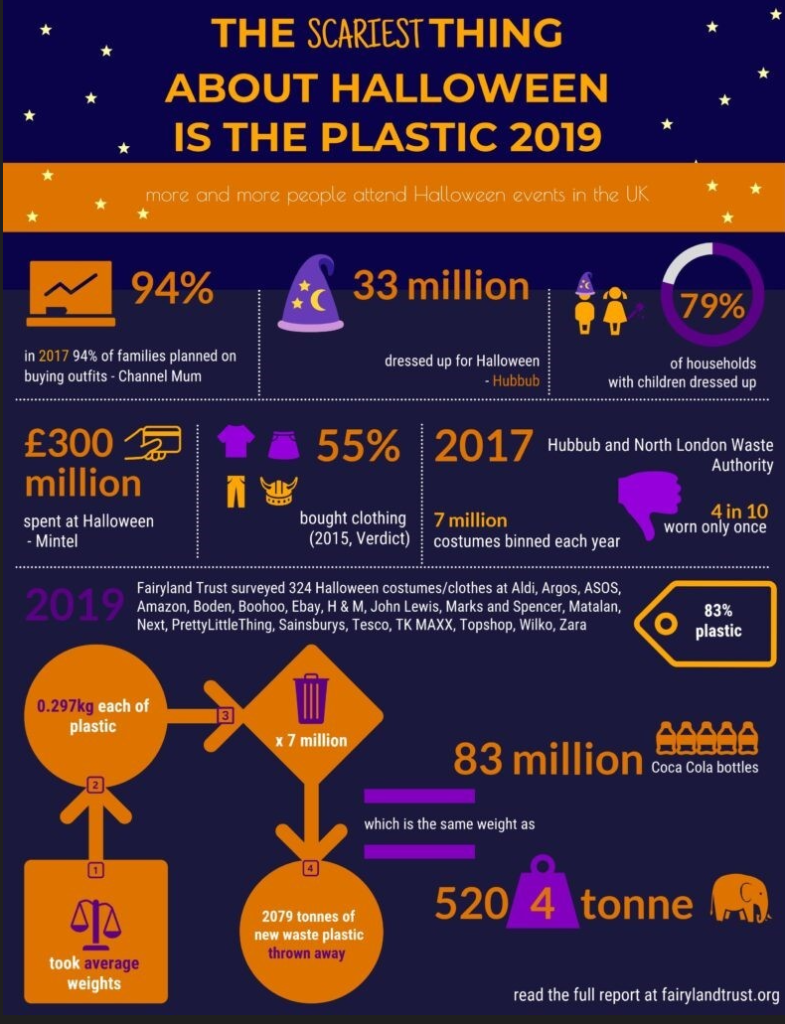
October 31st… time to consider our consumer habits. Consumers become motivated to buy new costumes each year as companies monetize on new culturally relevant products. This embodies harmful implications for fast fashion; fast-fashion refers to mass production of clothing based on rapid changing trends; inexpensive clothing is produced rapidly by mass-market retailers in response to the latest trends. According to Hubbub, 4 in 10 costumes are only worn once. Mass-produced costumes are typically made with environmentally harmful materials such as plastic. In the UK alone, 2000 tons of plastic waste are generated from consumption of mass-market Halloween costumes. High levels of waste and lack of sustainability in costume-based brands pose threats to the environment. Elevated production of disposable Halloween costumes means higher levels of residues mostly ending in landfills.
Around 80% of costumes are produced from cheap synthetics and non-recyclable oil-based plastics (polyester for example). Polyester, the plastic polymer used in over 63% of these costumes, takes between 20 and 200 years to decompose. These materials are non-biodegradable and difficult to recycle; meaning most Halloween costumes are destined to end up in landfill. Only in the US, over 5.4 million kilograms of textile waste are produced by businesses and consumers throwing away Halloween costumes, and yearly 7 million costumes are thrown out in the UK.
Other ethical related issues include the means of production, most costumes are usually produced overseas, mainly in China, where labour is cheaper and regulation on worker’s rights is more flexible. For instance, child labour has become a humanitarian concern in China’s production chains and sweatshops, it is believed that around 7.7% of children from ages 10 to 15 are working illegally.
In addition to waste produced by costumes, plastic sweets/chocolate wrappers, decorations, and pumpkin waste also contribute greatly to the amount of Halloween waste generated each year. The plastic footprint of Halloween is scarily large when taking into account waste produced by toys, decorations and food packaging; most of these products are made of single-use plastics, which are rarely recycled. Studies have demonstrated that a single “trick-or-treater” (person participating in candy recollection during Halloween celebrations) generates around half a kilogram of trash.
Cosmetics are one of the least regulated products of our time. Halloween face paint marketed for children usually contains harmful substances, as of a study made by Breast Cancer Prevention Partners, half of the 48 Halloween face paints sent to the laboratory for testing contained trace amounts of at least one heavy metal: arsenic, cadmium, chromium, lead, or mercury; some contained as many as four.
How can we celebrate a Green Halloween?
- Consider reusing costumes from previous years or making an outfit up from items you already own.
- Reducing candy wrapper waste: buying candies in bulk and avoiding individually wrapped pieces of candy and recycle plastic wrappers.
- Avoid using plastic bags for trick or treat
- Avoid toxic face paint: use this guide to identify harmful substances in makeup and other skin products https://environmentaldefence.ca/toxicten/
As we change our attitudes of consumption, brands will be eventually forced to reassess their fast-fashion approaches. Companies must aim for higher levels of transparency when it comes to raw material sourcing, production and recycling processes. Engaging in sustainable consumption and consciously choosing products with lower environmental impacts results in a shift towards greener means of production.
References:
Smithers, R. (2019). Scariest thing about Halloween is plastic waste, say charities. Retrieved from: https://www.theguardian.com/lifeandstyle/2019/oct/18/scariest-thing-about-halloween-is-plastic-waste-say-charities
Chaisson, C. (2019). Green Your Halloween. Retrieved from: https://www.nrdc.org/stories/green-your-halloween
O’Lear, C. (Oct 14, 2020). Seasonal Waste: A Look at Halloween and Our Planet. Retrieved from: https://www.seasidesustainability.org/post/seasonal-waste-a-look-at-halloween-and-our-planet
Wiseuptowaste.org . (n.d.). £510 MILLION 3 A YEAR SPENT ON HALLOWEEN COSTUMES, BUT 4 IN 10 ARE ONLY WORN ONCE AND 7 MILLION OUTFITS ENDED UP IN THE BIN LAST YEAR. Retrieved from: https://issuu.com/hubbubuk/docs/hubbub_2017.10.19_sew_spooky_press_